A Majestic Stratovolcano in Central Java


Rising gracefully to a height of 3,145 meters above sea level, Mount Merbabu stands as one of Central Java’s most captivating natural landmarks. Straddling the borders of Magelang, Boyolali, and Semarang Regencies, this majestic stratovolcano offers both geological wonder and spiritual significance. The name “Merbabu” derives from the words meru (mountain) and abu (ash), reflecting its volcanic nature. Ancient Javanese manuscripts, however, mention it as Gunung Damalung or Pamrihan, suggesting its sacred importance in early Javanese cosmology.
A Mountain Formed by Time and Fire
Geologically, Mount Merbabu was shaped during the Pleistocene era, making it one of Java’s ancient volcanoes. Its symmetrical slopes and ridges were carved by past eruptions, most notably in 1560 and 1797, with minor and unconfirmed activity recorded in 1570. Despite its dormant status today, Merbabu’s volcanic origins can still be traced through layers of lava domes and ash deposits that enrich its fertile soil, nurturing lush vegetation across its slopes.
Biodiversity and Natural Richness
Mount Merbabu is home to diverse ecosystems that transition with altitude — from tropical Dipterocarp forests at lower elevations to montane forests and Ericaceous shrubs near the summit. These habitats support a remarkable variety of flora and fauna, including edelweiss (Anaphalis javanica), the mountain’s signature flower, and several endemic bird species such as the Javan hawk-eagle (Spizaetus bartelsi) and Javan scops owl (Otus angelinae). The cool climate and pristine air make the area an ideal refuge for wildlife and a haven for eco-tourism enthusiasts.
Trails and Trekking Adventures
Today, Mount Merbabu is celebrated as one of Indonesia’s most scenic hiking destinations. There are five main routes to the summit:
- Selo Route (Boyolali): The most popular and beginner-friendly path, offering wide savanna views and a direct sightline to Mount Merapi.
- Suwanting Route (Magelang): Known for its steep ascent and panoramic scenery, often favored by experienced climbers.
- Wekas Route (Magelang): Shorter but more challenging, with rocky sections leading to the upper ridge.
- Cunthel and Thekelan Routes (Semarang): Pass through dense pine forests and serene villages, ideal for those seeking a quieter trail.
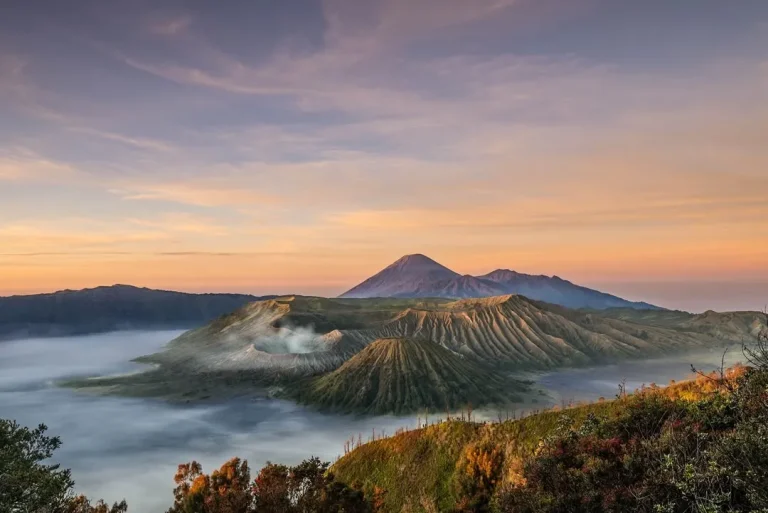
At the top, hikers are rewarded with a 360° view of Central Java’s volcanic chain — including Mount Merapi, Sindoro, Sumbing, Lawu, and Telomoyo. The breathtaking sunrise above a sea of clouds is a highlight that draws adventurers and photographers alike.
Culture and Sacred Traditions
For the local Javanese communities living around Merbabu, the mountain holds spiritual and cultural significance. Rituals such as larungan (offerings) are occasionally performed to express gratitude for nature’s blessings. Many locals regard Merbabu and neighboring Merapi as a sacred twin, symbolizing the balance between destruction and creation — a reflection of Javanese philosophy about harmony between humans and the natural world.
Tourism and Conservation
Mount Merbabu was declared a National Park (Taman Nasional Gunung Merbabu) in 2004, covering an area of over 5,700 hectares. The park’s mission is to protect its ecosystems while promoting sustainable tourism. Visitors can experience guided hikes, educational tours, and conservation programs focusing on reforestation and wildlife protection. Local guides and homestays in nearby villages such as Kopeng and Selo offer warm hospitality, traditional cuisine, and cultural insights for travelers seeking an authentic Javanese mountain experience.
A Journey Beyond the Summit
Climbing Merbabu is more than just a physical adventure — it’s a journey through layers of history, mythology, and natural beauty. From its whispering pine forests to its sweeping grasslands and sacred peaks, Mount Merbabu invites travelers to reconnect with nature and experience the timeless spirit of Java.